



OVERVIEW*
The PROBLEM
Hospitals discharge patients into complex medication regimens with near-zero onboarding—leading to preventable errors and avoidable readmissions. With hospitals penalized for 30-day readmissions, care teams need earlier visibility into post-discharge risk.
The SOLUTION
We designed Knouri, a B2B hospital tool for post-discharge risk monitoring. A proposed wearable supplies at-home signals, and our portal helps case managers quickly spot risk and route concerns to the right care team.

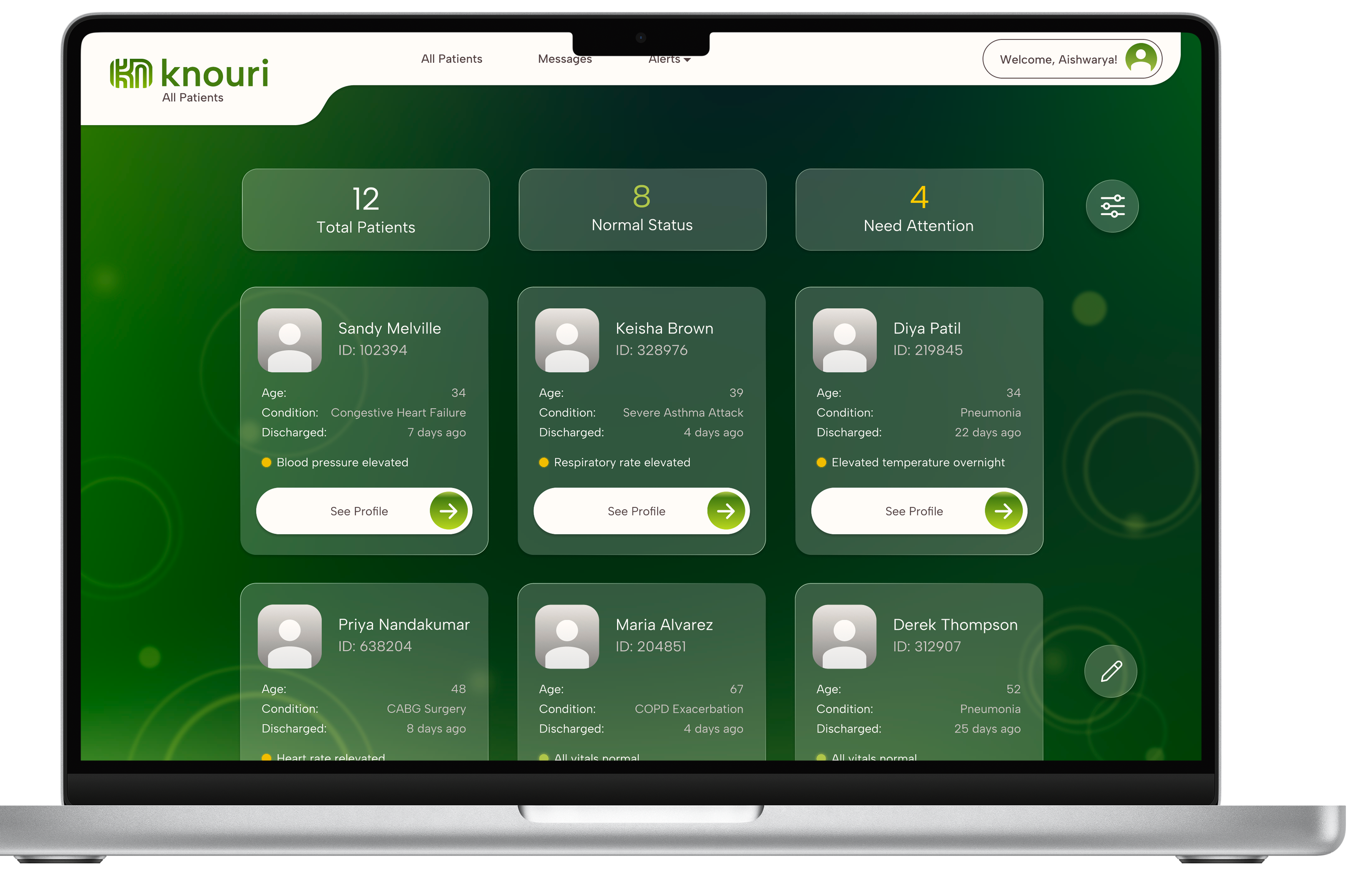
At-Risk Visibility
A status-first dashboard that makes alerts hard to miss, spotlighting the most urgent patients.
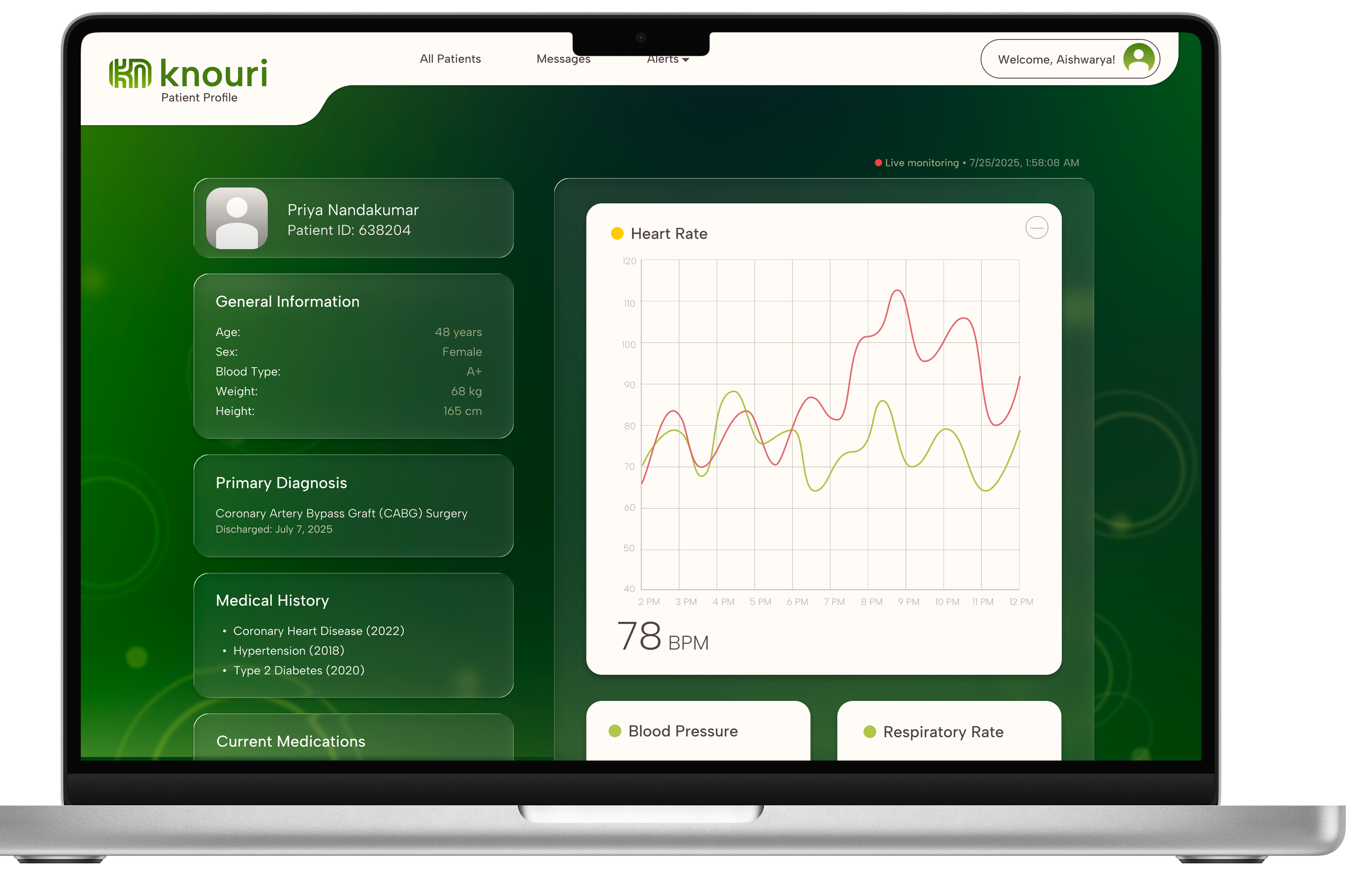
Profile in One View
A consolidated patient profile with vitals & history, so teams can decide faster without hunting across systems.
Escalate Without Friction
A streamlined handoff that flags concerns and routes them to the appropriate clinician—fast.
A clinical-grade portal that keeps care continuous beyond the clinic walls.
My CONTRIBUTION
Knouri was the first problem our team pursued that survived every validation stage. After cycling through multiple concepts that failed at later gates, I proposed the post-discharge medication onboarding + monitoring angle, and shaped it into a direction the team was genuinely invested in.
Within our triad of designer, developer, and product manager, I led the UX/UI for the care-management portal, translating research and validation constraints into the core flows and a cohesive interface.
I also designed the initial patient willingness-to-pay survey, synthesized the findings that prompted our pivot from consumer to B2B, and built the final pitch deck narrative and visuals for presentation.
RESEARCH*
Our MARKET AUDIT
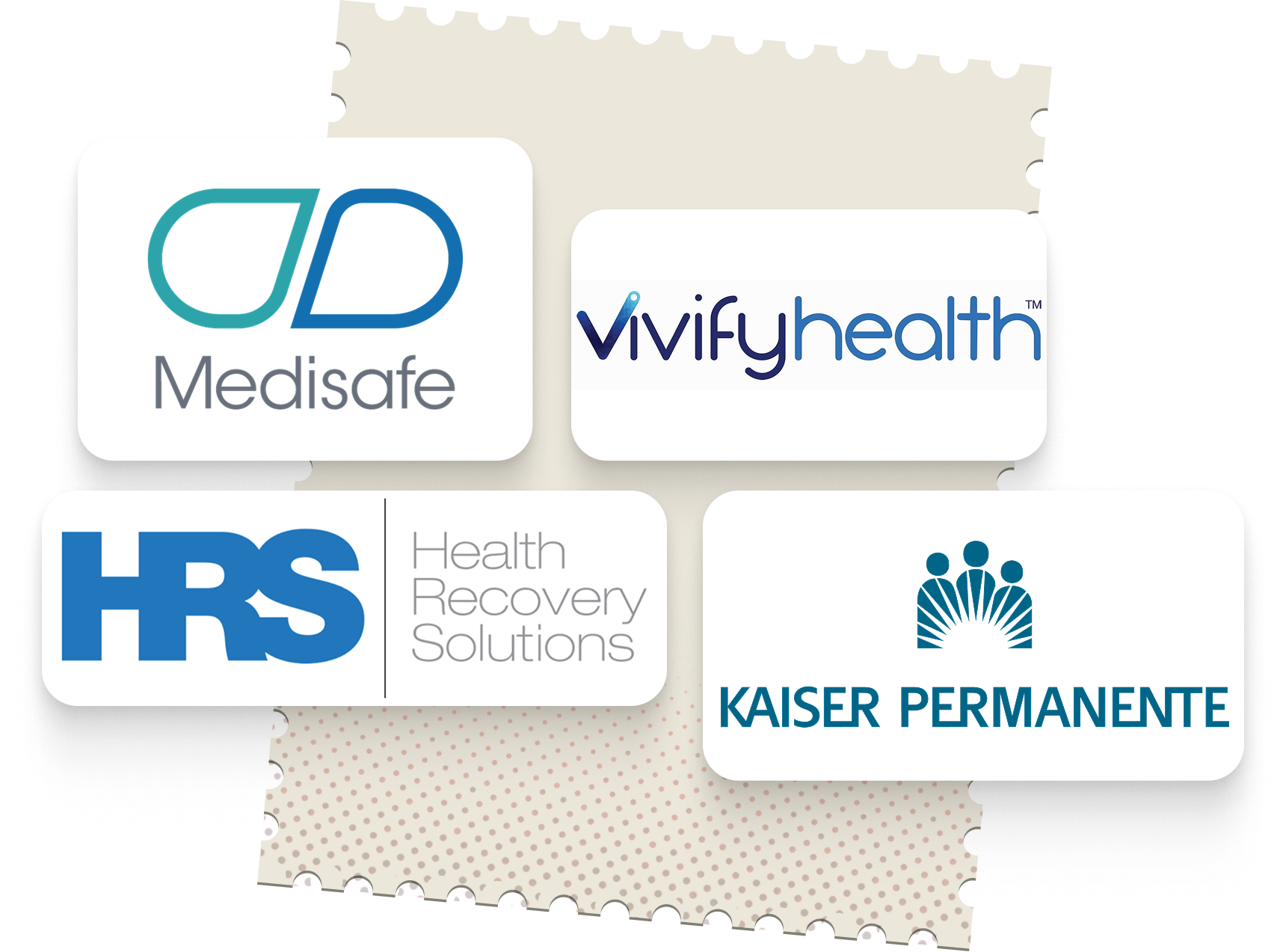
We audited existing adherence and transition-of-care tools to see what they solved—and what they missed, particularly for care teams post-discharge.
- Medisafe: Strong patient reminders, but largely self-managed; doesn't give hospitals a reliable post-discharge visibility layer.
- Vivify Health: Remote monitoring infrastructure, but often program-heavy and not designed around medication onboarding as the core workflow.
- Health Recovery Solutions: Offers RPM tools and tablets, but the experience can feel like equipment-first, not "case manager triage-first."
- Kaiser Permanente (Transition Program): Effective care transition model, but it's system-specific and not a scalable product a typical hospital can adopt quickly.
Existing solutions either optimize patient self-management or require heavyweight programs.
MISSING?
A care-team workflow that translates at-home signals into clear triage and escalation.
Our SURVEY RESULTS
Primary Research: Post-discharge survey (n = 20)
We surveyed people with recent discharge medication experience to understand (1) how instructions are delivered, (2) where breakdowns happen, and (3) whether patients would pay for help—before deciding who the product should serve.
Key Findings
CONCLUSION?
Patients need support, but hospitals have the incentive + budget to pay.
This pushed Knouri from a patient-paid tool toward a B2B care-team portal, where risk signals can drive earlier outreach and reduce costly readmissions.
Why HOSPITALS?
Readmissions, especially within 30 days, are the hospital-facing outcome of the same breakdown: when patients leave with complex meds + minimal onboarding, small mistakes (missed doses, doubled doses, unmanaged side effects) can escalate into avoidable return visits. For hospitals, those returns are expensive, strain capacity, and can also carry reimbursement penalties—making "prevent avoidable readmissions" a clear B2B wedge for Knouri.
The average cost of a patient readmission is $15,200.
Annually, $52.4 billion is spent on 30-day readmissions.
— National Institutes of Heath (NIH) Study
DESIGN*
Our HARDWARE
Early post-discharge risk is often invisible in routine documentation. Patients may be home for days before a problem becomes visible to the care team. We proposed a conceptual wearable that captures and transmits vitals back to care teams. Hospitals would rent the device to patients at discharge and collect it back after 30 days—the highest-risk post-discharge window and the same timeframe hospitals are most incentivized to prevent readmissions.
Our SOFTWARE
Those signals feed into Knouri's B2B care-management portal, where case managers can triage at a glance, drill into patient profiles, and escalate concerns to the right team quickly. Because this system handles patient data, we treated HIPAA + privacy-by-design as baseline constraints from day one.
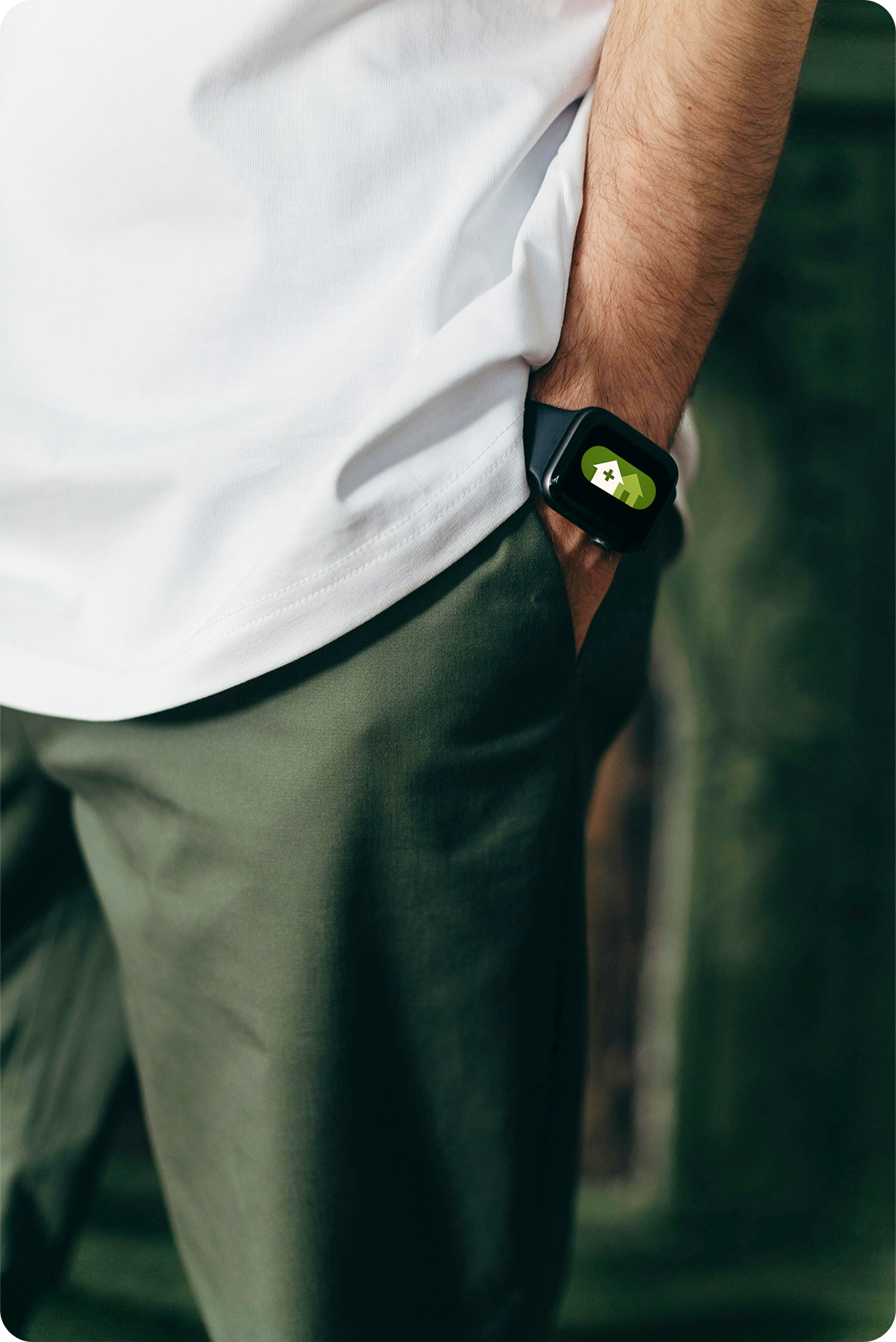
My DESIGN ITERATIONS
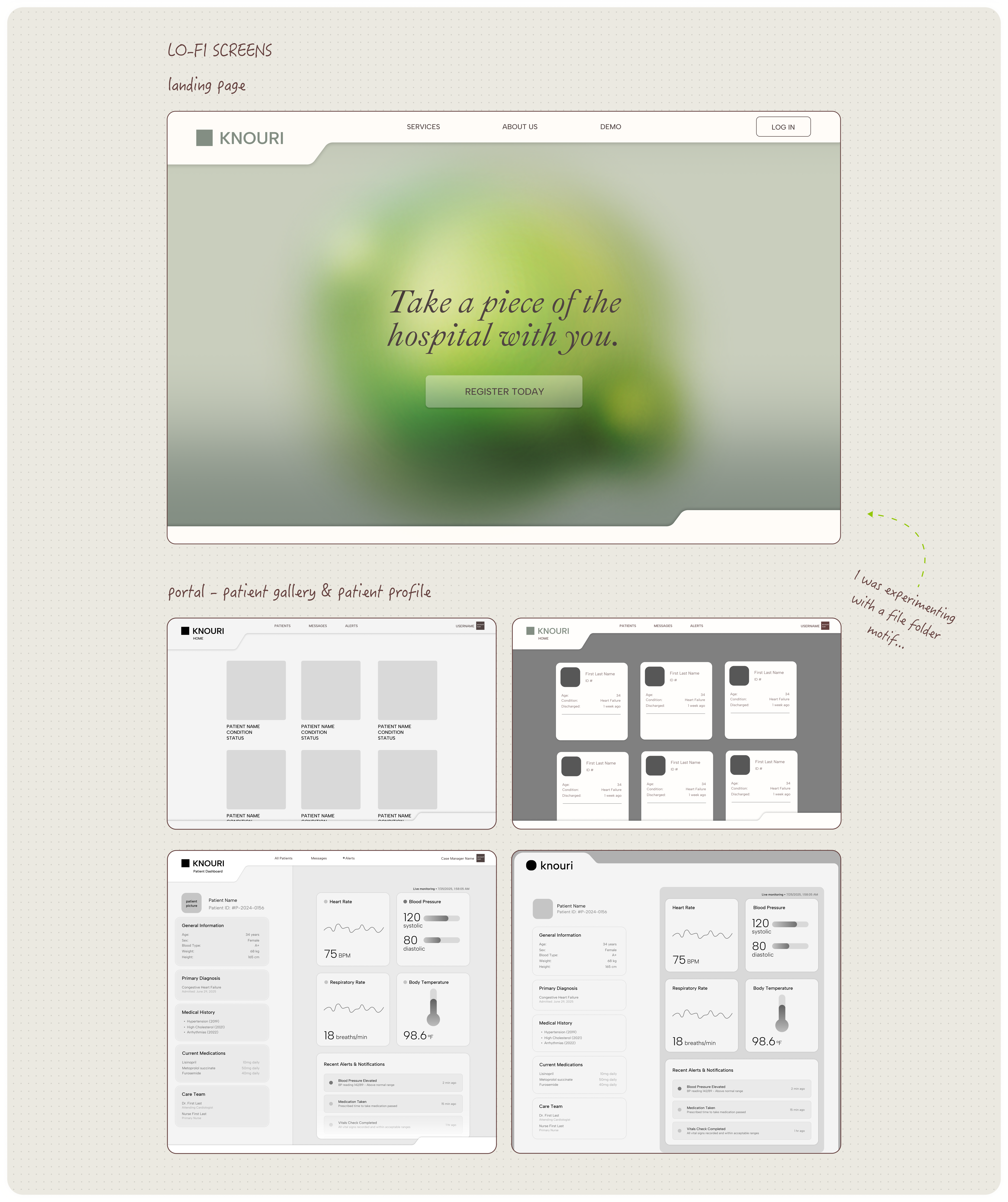
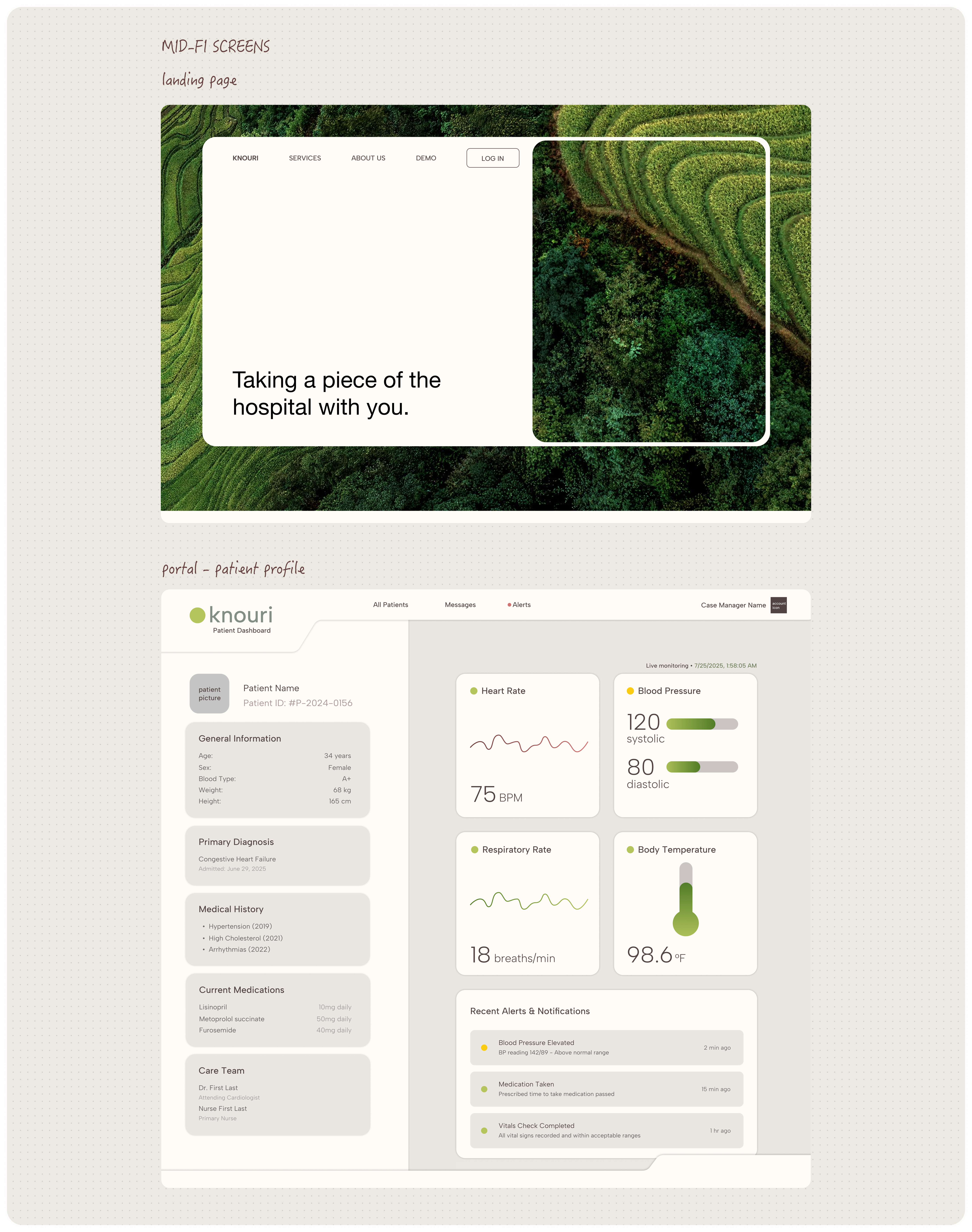
I designed Knouri's UI to prioritize scan → focus → act. I kept typography intentionally plain and high-contrast for quick comprehension, while I ensured the color palette avoided typical hospital whites and reds in favor of calmer, nature-forward tones that reinforce recovery and reassurance. Bright color is treated as a limited resource: it appears primarily in patient status alerts, so risk is visible at a glance without overwhelming the interface.
Our FEEDBACK
We presented our mid-fi designs to internship leadership and gathered targeted critique on positioning, visual language, and clinical depth:
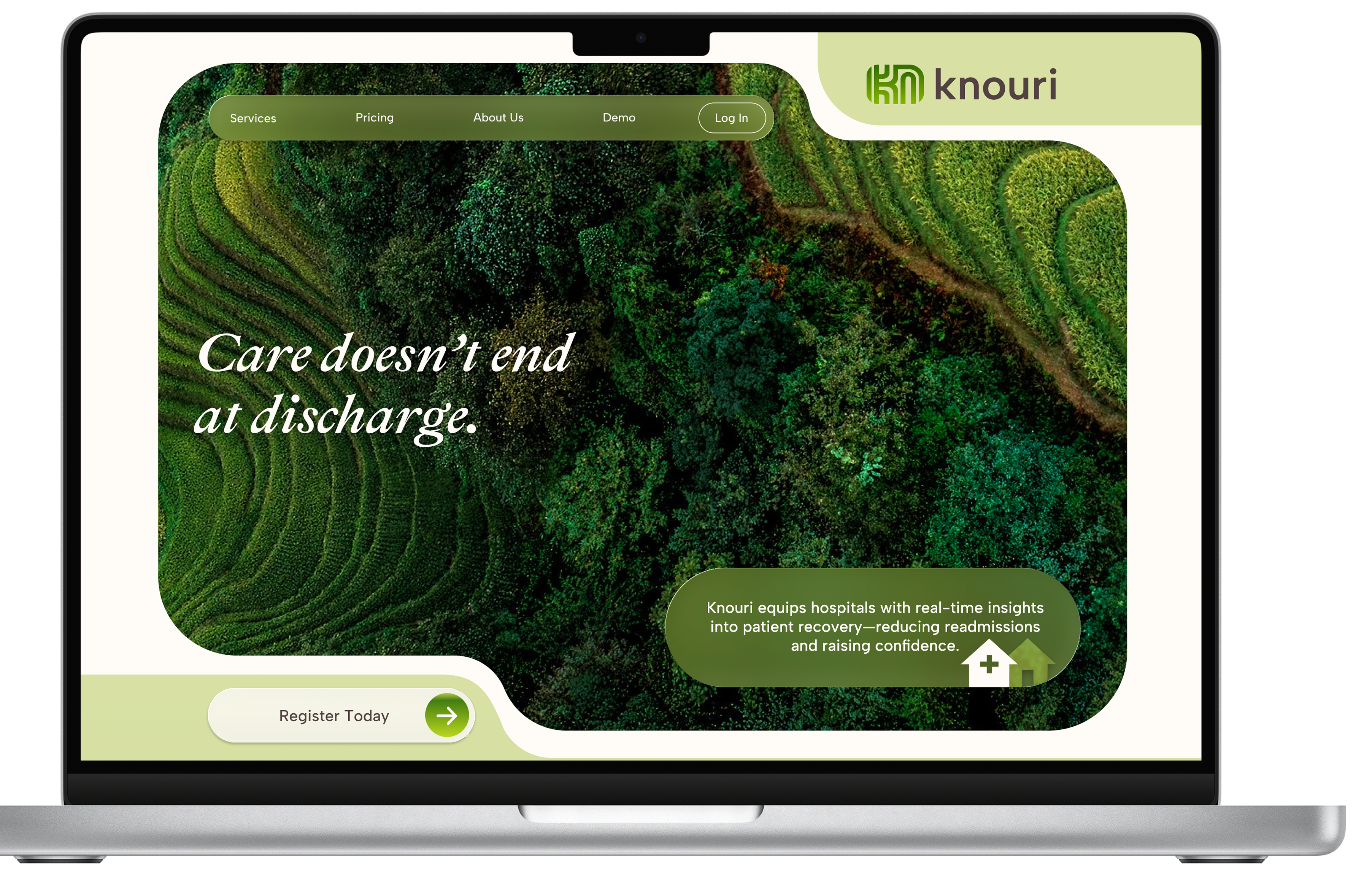
- Refine the tagline: "Taking a piece of the hospital" felt unintuitive—patients generally want to leave the hospital, not bring it with them.
- UI clarity was a strength: the interface read as clean, calm, and easy to scan.
- Simplify the visual motif: the file-folder metaphor wasn't adding meaning and could be removed.
- Expand clinical usefulness: reviewers wanted the vitals area to support deeper detail (e.g., trends and drill-downs), not just high-level values.
Our FINAL PROTOTYPE
REFLECTION*
The RESULTS
By the end of the project, we had a pitch-ready concept supported by key artifacts: a B2B admin onboarding flow, a case-manager dashboard prototype, and a defined care-team escalation model. On Aug 14, we presented Knouri to an external industry review panel (J.P. Morgan, Vanguard, Salesforce) and gathered professional feedback on feasibility, clarity, and go-to-market framing.
My FUTURE CONSIDERATIONS
Next, I'd prioritize in-person interviews with the stakeholders most central to adoption—hospital administrators and case managers—to validate workflow fit, procurement requirements, and which recovery signals are truly actionable. Because patients were more accessible, our primary data leaned toward patient responses supplemented by research literature; future work would intentionally rebalance toward care-team input.
I'd also be interested in the engineering feasibility of making the concept real, especially around wearable signal capture, secure transmission, and HIPAA-aligned handling of sensitive data.

FIN.*